Alexandra Teague
[And after, when I don’t know which way the sky is]
I wear my dead friend’s shirt to the shore,
and the lake sloshes in, and she does not appear
to blow up a floatie shaped like a hot dog squiggled
with mustard; she does not pause, grinning and winded,
a former swimmer who wrecked her shoulders, so by the time
we met, she’d bob in sharp mountain ripples, laughing
as she’d laugh, head thrown crookedly back, at our inventions
we’d inflate sentence by sentence: that if we’d just imagined
our college was the movie Oklahoma, with our deans in calico
singing songs she knew the words to (as she knew all lyrics, and sang
me through the phone, with her PICC line running one more bag
of platelets), it’d all seem less awful—bureaucracy and fevers—
if we just imagined administrators in overalls belting out Brand-new state,
Gonna treat you great! it wouldn’t seem so serious: the never-signed
paperwork, the hiring and sick leave—But you can feel something’s off
in the scene, she said, laughing as she spun the metaphor further:
the background’s shallower than it should be. What’s that weird foreshortening
with the clouds and hay bales? A thing only an artist would think—
of course our life’s a soundstage—a thing only she
would think of, the way she told me the radiation room looked
like a student sculpture: a bicycle seat sort of thing, metal bars,
two sheets of plexiglass she had to place herself between. I’d give it
a ‘B’ she said; What’s the bike seat doing? And why the plexiglass?
You haven’t thought this through enough. No, the world had never—
never will—think it through enough.
Her, during that last call, watching
out her hospital window, eight floors down, rabbits in the grass,
and, beyond, on the lake, a children’s sailing camp—gaggle
of tiny boats circling in the distance—cute, she said, but you know
those kids are being little shits to their counselors, spoken like a former
swim coach, like a professor who thought she’d someday be
a mother, who wanted to blow this world up, not bomb-like,
but putting her diaphragm into it—puffing up that slightly
phallic vinyl hot dog, then another, so the lake could
for awhile, for as long as we got, or got together, hold us.
Words Lost/Misplaced/Somewhere in the Studio
Borrow first, talking to a colleague—trying to say, it borrows the language
of counterpoint from music, only “borrow” isn’t there, has borrowed
from the air around us, on the corner of Washington and 6th, a silence,
a reaching, a wheelbarrow-shaped curvature where a word could be, heavy
glitch of space, in which I hesitate, then almost say a different word (trick
learned from learning Spanish; fancy tongue-work around what I can’t
express), but then it comes—the simple two syllables of: borrow! Though
I try to say it calmly, not an exclamation, but an ordinary sentence as if
there are ordinary sentences this strange September in which you’re gone
into a studio of space, where there is so much nothing to make, where there
is so much not thread not needle not canvas not velvet not branch not glue
not screw not hinge not two-by-four not tile you are not trying to grout
with velvet’s soft, uncanny moss, not upholstery wrapped into root not
porch swing below that haunted Southern blue yawning open into roots
that tangle and tumble from its splintered slats. Of course I have to borrow
from the air. Of course I have to borrow from the art you are not making
with the hands you do not have now—such expressive hands—to say that.
Edge Poem (Everywhere Velvet)
for Stacy
When I tell you I want to write about a woman
poised to become a sculpture—making herself
marble before marble, you ask me what about the toes?
And I say, toes? And you say, inching over the edge
of the pedestal. Haven’t you noticed, how often a woman
in her garlands and robes is also almost stepping away and off
the ledge of her own allegory? Beauty. Memory. Justice. Whatever
grand idea we want to tell ourselves. It’s the toes, you say, that tell
the real story—how the woman, how the sculpture, how time
could not hold still, the sculptor feeling it in her chisel (you do
not say this exactly; I’m embellishing; I’m trying, as I will always have to
now, to see the world as you did—to imagine what it is to hold a rock
and see its waiting skins of velvet). To take needle to socks, upholstery, wood, and twine
your own raised roots. To build a velvety beanstalk, leaf by leaf to the ceiling and then who knows
how much farther—who knows where any of us are going when our bodies touch
this world and its fibers, its soft peach fuzz, its screws and scab-barked
branches that days before the first time in the hospital I watched you try to pry
from a two-by-four because your drill wasn’t charged or wasn’t in your studio,
I don’t remember why because we were busy talking, as we were often talking
about something: sky and words and blue and tiny beads hinging
a shutter to the air; and you were stubborn, as you were, yanking at that branch, which twisted,
but wouldn’t give, although you’d decided it didn’t belong there. You,
wholly engrossed and moving through piles of your own making, gesturing wide
like a woman who’s stepped right off all pedestals to kick up shit
in her work boots—toes closed for working metal, for teaching students to weld,
to wield a staple gun, to make a sandwich stuffed with hair, their original
strangenesses. Stop trying to cram your thoughtsinto tidy squares
for Instagram, you’d say; let them take up space; stop trying to balance on the pedestal of clicks
and likes. Not that you didn’t often feel pedestal-stuck or struck by work-
patriarchy-expectations-exhaustion-that-damn-drill-
not-here-when-you-needed-it, but that you saw a caution line
and straddled it anyway, or reached to touch the sculptures in museums
as once you told me more people should, sneaking fingers
onto slick marble legs (whatever you could) because what is a sculpture
but another body, and us there at eye-level, waist level, chest level. You were always thinking
where we were in space—in relation—but where
in all this space now are you? Where
are you, but everywhere velvet maybe—or in threads in the air between us, this world so tactile
and textured and teasing with roots we haven’t found the end of. Oh friend,
who always said to me you’ve got this, friend, when I doubted words or vision, what ledge
can I stand on to peer over and reach you? Wherever it is, I will stand there
in my strappy sandals, my feet with their crooked
human toes just over the edge of this chasm where your future is.
Alexandra Teague is the author of the poetry collection [ominous music intensifying] (Persea 2024) and Spinning Tea Cups: A Mythical American Memoir (Oregon State University Press 2023). She is previously the author of three books of poetry and a novel, as well as co-editor of Bullets into Bells: Poets & Citizens Respond to Gun Violence. A former recipient of fellowships from Civitella Ranieri and the NEA, and a 2026 Idaho Commission on the Arts Literature Fellow, she is a professor of creative writing and chair of English at University of Idaho.
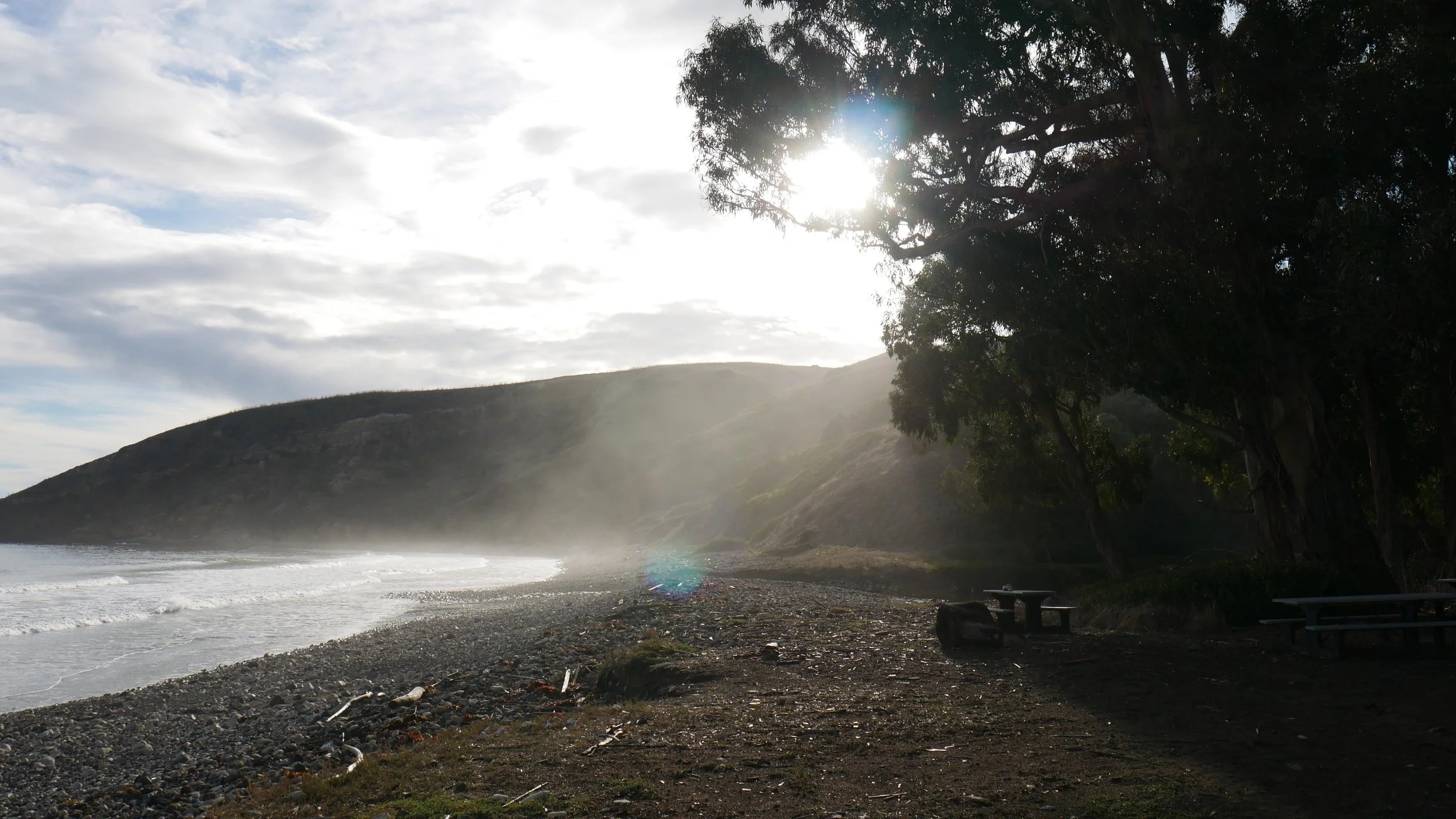
Artwork: “Daybreak” by Daniel Lurie
Digital