Gianna Starble
Millennial
“…and you burst out of your mother like a comet!” is what her father has said for as long as she can remember. A birthday ritual: the girl and her father would sit on the leather sofa with sticky summer skin and flip through her childhood photo album. All the 4x6 rectangles revealed a squishy cannellini bean with dark tufts of hair — one dressed as a green dinosaur on Halloween, one wrapped in red velvet for Christmas. Her mother let her bang on pots and pans with kitchen utensils. “My little Ringo Starr!” her mother crooned, applauding at the tin tin tin of the whisk hitting the colander. Her parents believed she was “special,” the way she would retreat behind the lilac bushes gathering sticks, dandelions, and seed pods in an old Tupperware and mash them with a rock to make “medicine.” At holiday parties, the girl would put on performances, re-enacting The Little Mermaid wrapped in a white feather boa and her mother’s turquoise heels four sizes too big. “What a ham!” the adults laughed, twirling their third glass of pinot noir. In the fifth grade, she landed the role of Orphan Annie in the school musical. Her mom dyed her dark brown hair poppy red with two boxes of Revlon. "This is called method acting” her mother said as she smeared strands of hair with goop resembling curdled blood as the girl cowered in the bathtub. When the elementary school music teacher told her mother “Your daughter shows real promise,” she dragged the girl to auditions: community theatres, talent agencies, commercials for McDonalds. A recruiter from John Robert Powers told the mother “Girls her size don’t make Disney.” The mother gave the girl chalky protein bars as meal replacements for the next month. The girl watched and rewatched Passport to Paris on VHS and observed the difference between her body and Mary-Kate and Ashley Olsen’s — a difference she could correct with determination. Her father coached her club soccer team. At practice, he made them do suicides, run touch the white line run back and touch the goal line while he spat from off field “NO STOPPING.” When they lost a game, the girl would sit with her head down pulling fistfuls of grass as her father, with stinging silence, loaded the Dodge Grand Caravan with orange cones. Before entering middle school her parents discussed “What about her education? She’s gifted in so many areas…” They brought her to a grey building in the city where she waited in a room with other kids. First, they took a test and filled out bubbles with No. 2 pencils. Then, she went into a conference room with three adults, who all looked like people who finish The New York Times crossword every Sunday. They asked questions like “What are your favorite subjects?” and “What would you like to be when you grow up?” to which she responded (as rehearsed with her parents) “a lawyer.” The girl was accepted to St. Mary’s private school. Her parents were so pleased, they took her to Cold Stone. “See, honey? You’re Special! You can be anything you want to be!” they told her as she gripped a sugar cone with cookies and cream, watched it melt white tears, and evaluated the sensation of the word S-p-e-c-i-a-l settling in her body. At St. Mary’s, she wore a pleated navy skirt that felt like sandpaper on her thighs with a white polo tucked under a square navy sweater to match. The girl pretended to eat by herself in a shiny, white cafeteria until one day in the eighth grade, a girl named Hazel sat beside her and asked, “Do you smoke cigarettes?” Hazel led the girl behind giant, green dumpsters and showed her how to use a Bic lighter, how to inhale and not look stupid. When the five-minute bell for class rung, she felt the nicotine coat her system like cool silk sheets. The girl felt something — something she couldn’t name — but knew she enjoyed smoking cigarettes with Hazel more than practicing Debussy in Mrs. Shoemacher’s living room. In the ninth grade, the girl began reading Virginia Woolf, Sylvia Plath, and Anne Sexton. When she read The Catcher in the Rye in the tenth grade, she thought Holden Caulfield was the only person who could ever understand. Over dinner she told her parents, “I just want to be a catcher in the rye, catching all the laughing children,” causing them to nearly choke on their asparagus. Report cards decayed like an old house, from As to Bs then suddenly Cs and Ds. When grounded, she would retreat to her room and listen to The Milk Eyed Mender on her Sony stereo, imagining twisted faces on the wall. She stopped going to first period, then second — to walk to the 7 Eleven with Hazel to buy drip coffee and Marlboro Reds, then watch boys at the skate park. In the eleventh grade, her parents got her a tutor for the ACTs, a guy named Josh who just moved back after graduating from Stanford. They would start with algebra and end by making out on the girl’s bed. The girl took the ACT and scored a 19. Her parents wilted like daisies. The girl took the ACT again and scored a 19. Her parents fumed like gun smoke. The girl took the ACT a third time, after switching tutors (to Ian, who is boring with acne like the planet Mars) and scored a 21. “How will she ever get into Tufts?” her parents sobbed into their Chardonnay at the dinner table while the girl didn’t make eye contact, just looked at the dead rockfish on the blue and white porcelain. The girl applied to twelve different institutions: Tufts, Sarah Lawrence, NYU, Brown, Amherst, Vassar, Wesleyan, Bates, Middlebury, Northwestern, Oberlin, and Barnard. The letters came in the mail like dying relatives. The girl was rejected from eleven and weight listed at Sarah Lawrence. Her parents feigned optimism. The girl’s dad drove over an hour south to play golf with an old high school buddy who heads the admissions office at Sarah Lawrence. When the girl was accepted off the waitlist, her parents helped her settle into the dorms, purchasing her a comforter and matching sheet set from Urban Outfitters. As they said their goodbyes, her mom handed her $100 and said, “Be safe. We’re so proud of you.” At college, she bought Adderall from the guy down the hall in 10C and went to the library with the study rooms that smelled like moth balls and peered out the cold windows to the iron lamp posts that gloomed like ghosts. On Friday nights, she would go out with a friend from French class, taking the train into the city, where she was let into clubs and ordered vodka sodas with her fake ID. When they rode the Harlem train home — the world blurring by, her body maintained in a steel capsule with all the other aimless bodies — the girl felt possible. The girl failed all her classes her first semester, with the exception of Women and Film, in which she earned a C. She didn’t see the point in continuing and asked her parents for $3,000 so she could take a gap year in India and become a certified yoga instructor. The girl studied in Rishikesh and returned with henna swirled on her hands and forearms and a small hoop in her right nostril. The girl felt enlightened and envisioned teaching yoga to the movie stars. She moved to Los Angeles, lived in a small apartment near downtown with three other girls who had eating disorders and auditioned for films. One of her roommates convinced her to go to an open casting call for Crazy, Stupid, Love. She got called back, and although nothing came of it, the mirage of an open door propelled her. The girl started going to auditions and asked her parents for money so she could get professional headshots and take acting classes. The girl was told by the casting director of Grey’s Anatomy that her face is forgettable. Between teaching yoga in Silver Lake and a barista gig in Studio City, the girl couldn’t afford Los Angeles anymore and was tired of continuously starving herself for a stagnant acting career. One night, she fell down a rabbit hole of gastronomic YouTube videos, marveling as the chefs from Alinea made balloons out of inverted sugar. The girl decided to move to Chicago, to restore her love of food through the art of creation. In Chicago, she applied to kitchen jobs and found luck by walking into restaurants wearing her lowcut Free People dress with no bra and red lips. She got hired at a French fusion place as a pantry cook, where she plated tartar with radish microgreens and cured egg yolk. The girl was thrilled when she perfected scooping a quenelle of crème fraiche ice cream onto a flourless chocolate torte. When she rode her single-speed bike down Milwaukee Ave., after whiskeys and PBRs with the other line cooks, the skirt of the city like a giant cape sparkling on her shoulders, the illusion of success did not matter. But the sous chef was more interested in accidentally touching her ass than teaching her how to brunoise a shallot, and the head chef (when he was there, usually red-faced and booze-breathed) yelled at her for taking artistic liberties dotting the cheese board with red wine reduction, and she made barely enough money to cover rent for her Wicker Park apartment. The girl looked for corporate jobs on Indeed, which made her chest tighten like a rubber ball. The girl applied to 42 different listings over the course of 6 months. At an interview for a temp agency, a woman squinted at her resume, which was sporadic like a 3rd graders cut-out collage, and said, “Do you realize there are graduates from Northwestern and the University of Chicago applying for temp jobs?” Riding the train from one fruitless interview to the next, the girl listened to The Suburbs on repeat, flint sparking in her ears at the refrain, “I need the darkness, someone please cut the lights.” The girl miraculously landed an entry-level position at a start-up called Zinger that apparently provided financial assistance to small business owners, or something. In a tall glass building she makes phone calls from a bouncy ball and drinks LaCroix and craft beer from the communal fridges with other millennials who like talking about podcasts like Freakonomics Radio. The girl hates this job. Upon hearing about the girl’s semi-stable employment, her parents come to visit and take her to a steak house on Michigan Ave. “We’re so pleased about your job! This seems like a company you can really climb your way up,” they smile over prime rib. The girl stares at the precipitation building on her water glass and imagines a river washing her away. The girl goes back to her apartment with the roommate she’s only seen twice and three dying house plants. The girl goes out to the fire escape with a mason jar of Rex Goliath and a half smoked joint. The city of Chicago sings in little lights under a smudged night sky. The girl leans her head against the iron railing and feels water dripping from her eyes. You’re special! You can be anything you want to be! The girl sips the cheap wine, lights the joint with a Bic the way her friend Hazel taught her, and takes a long drag. “Just a catcher in the rye,” she says out loud to the dark, “that’s all.”
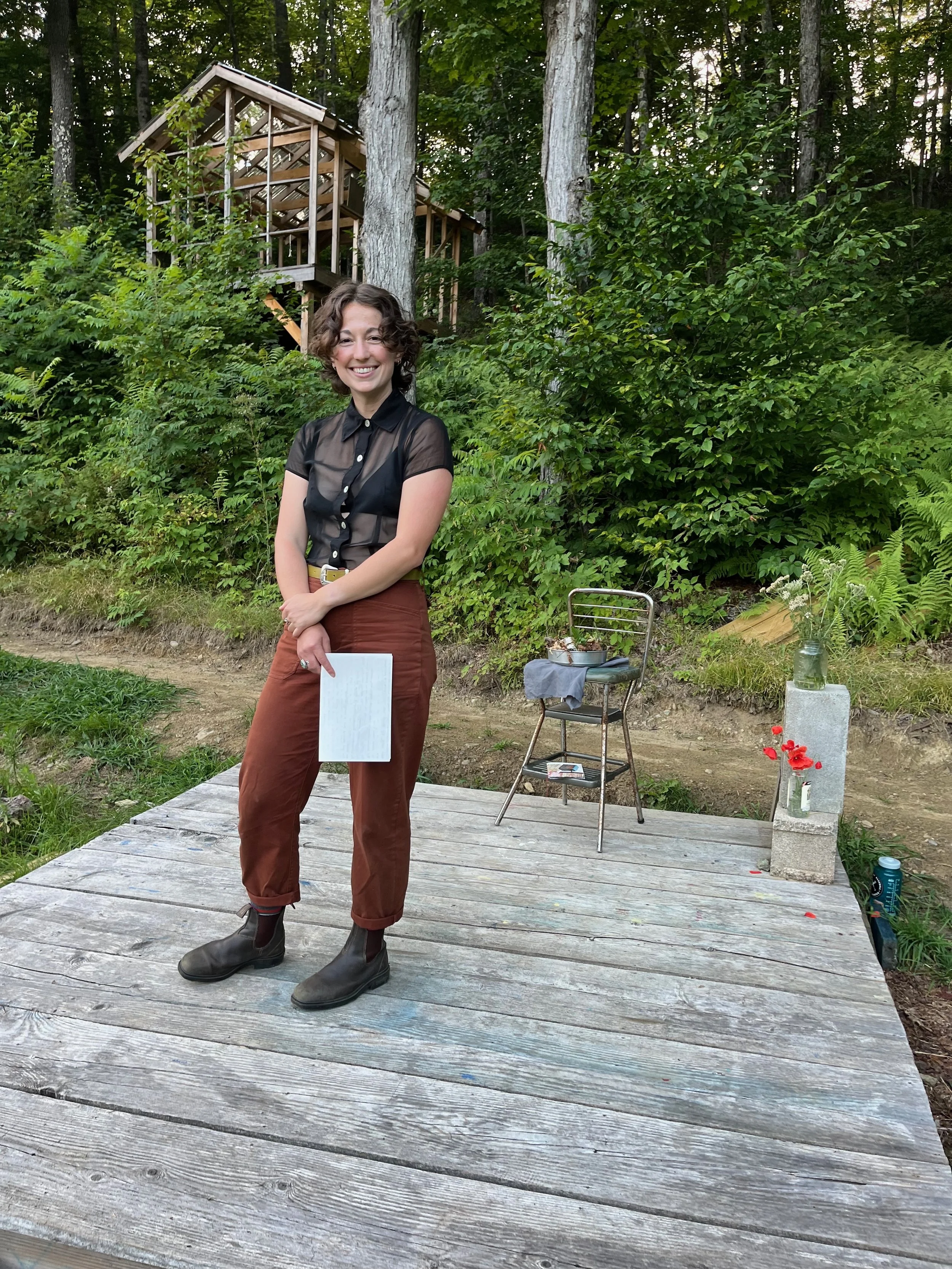
Gianna Starble (they/them) is a writer and performer with an MFA in Creative Writing from the University of Idaho. Their work has been featured in Foglifter, Fugue, and The Hunger. They’ve been an artist in residence at The Sable Project. They love dogs deeply, especially their dog, Blue.
Artwork: “Needles” by Daniel Lurie
Digital