Melissa Kwasny
What the Eclipse Knows
One thing you own is your own impending absence.
Not a darkening necessarily, not an illumination, but an ebbing either way.
Like the pause before an earthquake, a distortion of the panorama.
How your hands soften like raspberries do with age.
These could be your best years, surpassing those when you were young and sex-driven.
An interlude, like three rainy days with books in a cheap hotel.
What if the sun really went away? You now know that it could happen.
A key insight of psychoanalysis is that anxiety divides the world into good and bad.
In your dream, the book was titled The Eight Confusions.
The line between granting someone the freedom they need and erasing yourself in the process.
Meadowlarks throw themselves into the air and let the wind catch their wings.
They achieve a balance between intentionality and surrender.
The texture of water is also a question, whether it is the hand or the entire body plunging in.
How cold warmth can become in only minutes.
After the eclipse, the calves gathered around you like school girls around a bug or snake.
What allows for an automatic tenderness.
You were never taught you had an obligation to change the world, only to survive it.
What the Eagle Knows
Asterisk, little spider, someone has surely called you that from above.
The late winter fields, like blackened pennies, lined with dry coppery stalks.
Which appear as a radium-rich layer, a faint inscription.
You remember the day you tried to stop the mind from generating negative opinions.
You were riding, in the passenger seat, staring out at the winding slopes.
A kindness someone offered, or a difficulty.
The eagles may fly over the mountain, but they're on their way to the valleys to feed.
Afterbirth: the graven image of a little calf.
For hours, you watched the live cam of the bald eagle nesting, in case the eggs hatched.
It’s the float into view, as if on a wave, their black wings backlit.
How is your mental health today, asks the billboard, offering a line of six emojis.
Can you pinpoint the exact nature of your decline?
Proprioception: to know without looking whether you are standing on grass or concrete.
The old ways aren’t working say the occupants of memory.
You thought mere proximity to death would be more helpful, tone down the novelty.
What the Buffalo Know
Dorsal: the wide tines of bones arranged in a line stair-step up the animal back.
Insert the ghost flowers. We are brushed by many.
Antlers pocketed in the undergrowth, dinosaur fossils in the muddy banks.
The rock’s path is long, its shadow brief and dependent.
They fell in the crack between them, as if seeds cached for a more propitious time.
They were several in the trial life, in the primitive life.
Garnet-flecked, the rocks mark where they passed from earth into the supernatural.
In the expanding universe concept of time, what will they expand into?
The language of prayer's address is often feudal, hierarchical.
Why not praise instead the sun, the grasses, the rain itself? I mean, the lowercase rain.
There is always a point when it is too late to turn around.
What the buffalo calves know: how good their running feels to the pasturage.
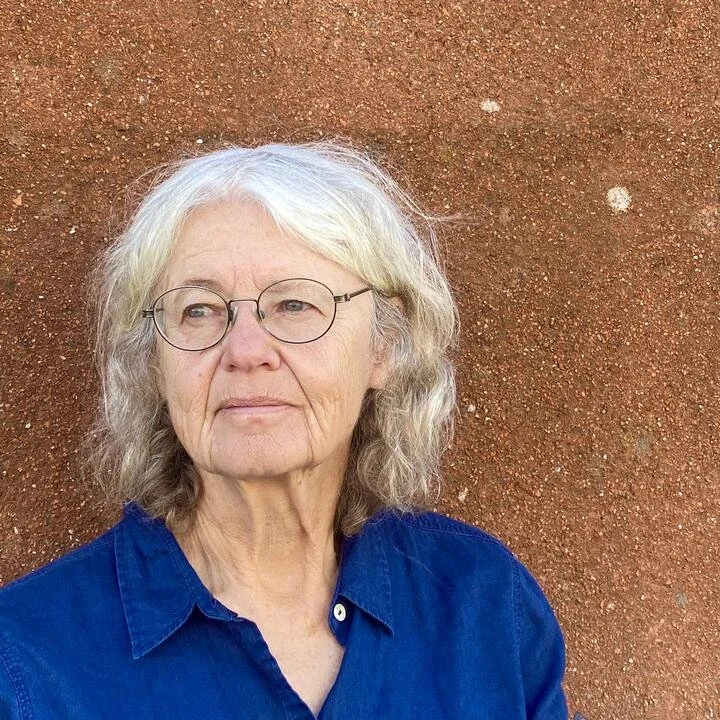
Melissa Kwasny is the author of seven books of poetry, including The Cloud Path (Milkweed Editions, 2024), Pictograph, and Where Outside the Body is the Soul Today, as well as a collection of essays Earth Recitals: Essays on Image and Vision. She is also the editor of two anthologies: I Go to the Ruined Place: Contemporary Poets in Defense of Global Human Rights and Toward the Open Field: Poets on the Art of Poetry 1800-1950. Her first full length nonfiction book, Putting on the Dog: The Animal Origins of What We Wear, explores the cultural, labor, and environmental histories of clothing materials provided by animals. She was Montana Poet Laureate from 2019-2021, a position she shared with M.L. Smoker.
Artwork: “Glimmer” by Daniel Lurie
Digital