We Each Suffer Grief Uniquely: a Conversation with Melissa Kwasny
OS: In The Cloud Path, many poems are framed as paths — like “The Cottonwood Path,” “The Lupine Path,” and “The Glitter Path.” How do you envision a path in a poem? Are you, as the writer, a guide?
MK: The poems in The Cloud Path were written in a time of grief — personal, political, and planetary. It was the time of my mother's slow and painful dying, and the years of the pandemic, when everyone I knew was grieving some kind of loss. There was also, at the same time, more and more news of species loss and climate change. It all seemed of a piece, a conflagration causing many of us to experience what Joanna Macy called "environmental despair." As I have always done when in crisis, I sought the kindness of the natural world, in particular the plant world. I went for walks every day, paying particular attention to what I encountered along the path. In other words, I was not the guide. As I write in another poem "The Willow Path," I came "for their peace and instructions." Throughout history and across cultures, humans have gone to plants to heal our physical, emotional, and spiritual wounds. Each path offered different encounters and different lessons. The title poem, for instance, references the paths of clouds, which are, like our paths, temporary and temporal.
OS: We’re thinking, too, about the poem “An Ascetic Impulse Surfaces, Tears Leaves From Their Stems” in which the speaker travels the route to her old house that has been reclaimed by nature: “Animals have made a new trail / to the water. Allowable, no longer frightened of me.” Are there certain paths where this collection’s speaker has less or more agency to travel?
MK: That's an intriguing question. As a poet, places or paths in the distant past, say in childhood, are less accessible to me, though there are many poets who seem positively clairvoyant in their ability to conjure such experience. I am more interested in keeping my eyes and ears open to the immediate. In the case of the poem you mention, I was visiting a place where I spent twenty years, and it was as if I had never been there. It was as if the past had closed in behind me, living a new, wilder life. Like a wound, the past had closed up. The person I was then, too, seemed less accessible. This was not a bad realization, but a hopeful one: the earth will be okay without me in it!
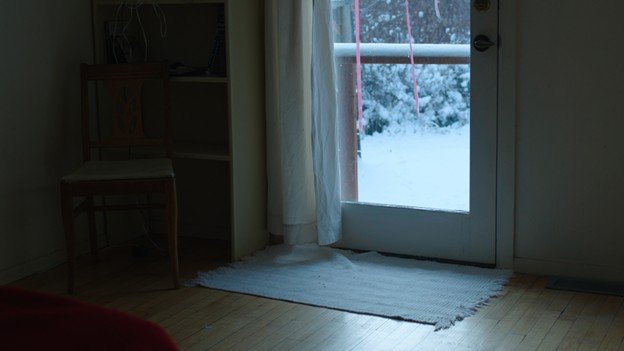
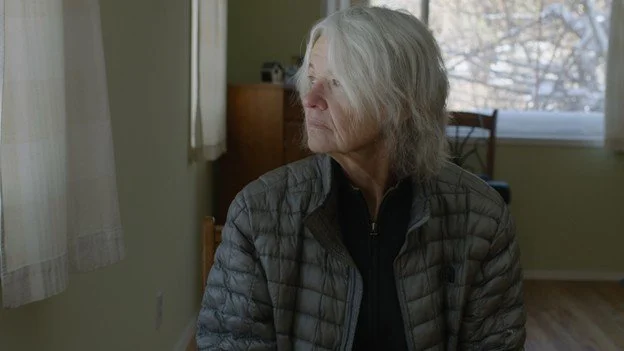
Another poem that covers similar ground is "Self-Portrait as Apparition." In that poem, I visit my former home in the mountains as a ghost might, moving "through the translucent / corridors, as the fish do." This was an actual experience. My house was empty; I hadn't sold it yet. Tenzin Phuntsog, an area filmmaker, contacted me. He was creating an immersive video project called "Portraits of Poets," wherein one film would be a long take of the poet in their act of writing, while a second screen would project the camera moving through the space in which they inhabit their creative world. As I was between homes, he asked if he could film me in my old one. It was deep winter. I went up alone before dawn to build a fire. Here are two stills from the film:
OS: We love “Self Portrait as Apparition,” and it’s wonderful to know more about its context. In it, you also write, “Who am I if I am voiceless? Voiceless, I am too aware / of my appearance — unprotected, genderless / and bare as a small girl.” How does aging reshape one’s voice and gender identity?
MK: The odd thing about the film was that it was to be a silent film. Imagine: a film about poets that separates them from their words! As Tenzin filmed, as I moved from room to room, I began to see my past as if from the outside, in various scenes, as if I were a stranger. I lost an emotional connection with the person who lived there. Many women will say that they become less visible to the rest of the world as they age. We also, I think, become less visible to ourselves. I find it a relief to escape the constrictions and questions of gender that begin to confront girls at adolescence and continue until we are old. But voiceless? How would anyone know who we are if we can't speak?
OS: The Cloud Path reckons with collective crises, like the COVID-19 pandemic and climate change, but it also explores personal or existential crises, especially as the speaker grieves her mother. How did the pandemic influence your writing practice and grieving process?
MK: My mother died at home with me and my siblings beside her in November 2020. I had been back and forth many times between Montana and Florida to spell my brother who was taking care of her. Because she was terrified of going to the hospital and no doctors would come to her home, my mother was bedridden for seven months and died without a diagnosis. It was a traumatic time for my family, as it was for so many. I think of all those in hospitals and nursing homes, dying alone, saying goodbye on the phone or on the other side of a glass door. Soon after my mother died, I trained to became a hospice volunteer, wanting to learn as much as I could about how to be more helpful to the dying and to those who grieve them.
Grief is universal. All peoples, and most animals, experience it. It is, paradoxically, also individual. We each suffer grief uniquely. It is perhaps our strongest emotion and yet the most difficult to describe to others. Poetry, I believe, gives us a language to do so. One form is the elegy. I began studying the elegy — one especially good overview is Peter Sacks's The English Elegy: Studies in the Genre from Spenser to Yeats — and collecting contemporary poems that I found particularly powerful. Eventually, I started giving writing workshops where people could learn to write poetry that expresses their grief.
OS: One of the aspects of your writing that we adore is your hyper-attentiveness to the natural world. The flora and fauna throughout your poetry are named, whether it’s a group of snow geese or bobolinks in a hayfield. Do you believe observation is a form of reverence? Is learning the names of different species a way to honor them?
MK: Denise Levertov writes, "The progression seems clear to me: from Reverence for Life to Attention to Life, from Attention to Life to a highly developed Seeing and Hearing (faculties indistinguishable for the poet) to the Discovery and Revelation of Form, from Form to Song." Black Elk said to John Neihardt, "Be attentive and you will live a holy life." One of my mentors, Susan Griffin, who wrote Women and Nature, and who recently passed, wrote, "Sharp perception softens / our existence in the world." I take these words as touchstones for my own writing process and my own life.
Learning the names of different species is not so much a way of honoring them as being able to distinguish them from each other and hence to pay closer attention. We do not know what trees and birds call themselves. It is humans who do the naming, whether using Latin binomial nomenclature (genus and species) or an indigenous language. Yet, if you want to know someone, the first thing you do is learn their name. It is really the first step to seeing someone as an individual.
OS: Your three poems in Issue 02 are called “What the Eclipse Knows,” “What the Eagle Knows,” and “What the Buffalo Know.” What’s important about giving language to non-human forms of knowing?
MK: Well, having paid little attention to anything but human knowledge has gotten us to the disastrous state we are in: our water, air, and soil are polluted, species are disappearing, the ozone layer is diminishing, and we are at constant war with each other. We are clearly not in imaginative relationship with the earth and its ways of knowing. Human beings in the past learned how to be human by observing the wisdom of plants and animals. Indigenous cultures wove their belief systems around this practice. Many tribes called animals their older siblings. Scientists are discovering, finally, that the earth is a living being, is a live mesh of rock and water, microorganisms and mycelium, animal and plant, all working together to create what we call life. Other cultures have arranged their lives accordingly. I hope we can change in time.
OS: These three poems are also part of a project you’re working on, and we’re so excited to read more of it! Can you tell us about this project and how you conceptualize it?
MK: The poems are all written in "aphoristic-like" form where each line is an end-stopped, complete stanza, meant to stand on its own. Traditionally, aphorisms are, as Northrup Frye writes, the standard rhetoric of wisdom. They are sayings meant to guide us in living a good life and to help us in our struggles. Heraclitus’s "You can never step in the same river twice" and "Character is fate" are examples of aphorisms. Long sets of aphorisms aren't meant to tell a story or necessarily connect to each other. As Frye writes, “the use of discontinuous aphorisms suggests to the reader that here is something [she] must stop and meditate on, aphorism by aphorism, that [she] must enter the writer’s mind instead of following [her] discourse.” The wisdom I seek to access, and learn from, is from the other-than-human worlds. I think of each line as a fragment, a piece of knowledge I have gained by deep looking and listening, a phrase broken off in the effort of translation from one species to another, an effort that brings me into a more intimate relation with the earth.
OS: What’s inspiring your writing lately? Do you have any writing rituals?
MK: I write by hand early every morning. I make tea and take it back to bed with me, along with a notebook I keep for that purpose. Sometimes I write for hours. It's also a good time to read poetry, which often leads me back to my notebook. As Donald Revell said, in his book Invisible Green, "Poetry is the fate of reading, a phase of transformation." Walking is a ritual for me; if I haven't been outside for days, my mind feels empty. My walking is usually focused on what I am listening for, so I suppose you could call it a ritual, as in something we do with intention. Praying, for me, is simply speaking with. You can pray with your dead, with trees, water, and animals. An essential part of speaking with is listening. I am trying to become more porous.
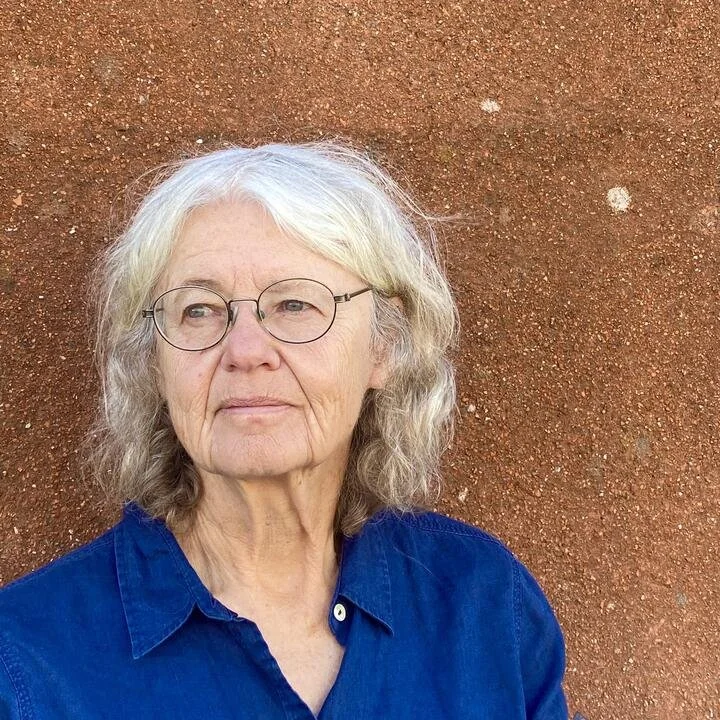
Melissa Kwasny is the author of seven books of poetry, including The Cloud Path (Milkweed Editions, 2024), Pictograph, and Where Outside the Body is the Soul Today, as well as a collection of essays Earth Recitals: Essays on Image and Vision. She is also the editor of two anthologies: I Go to the Ruined Place: Contemporary Poets in Defense of Global Human Rights and Toward the Open Field: Poets on the Art of Poetry 1800-1950. Her first full length nonfiction book, Putting on the Dog: The Animal Origins of What We Wear, explores the cultural, labor, and environmental histories of clothing materials provided by animals. She was Montana Poet Laureate from 2019-2021, a position she shared with M.L. Smoker.
Artwork: “Gather” by Daniel Lurie
Digital